
What’s it for?
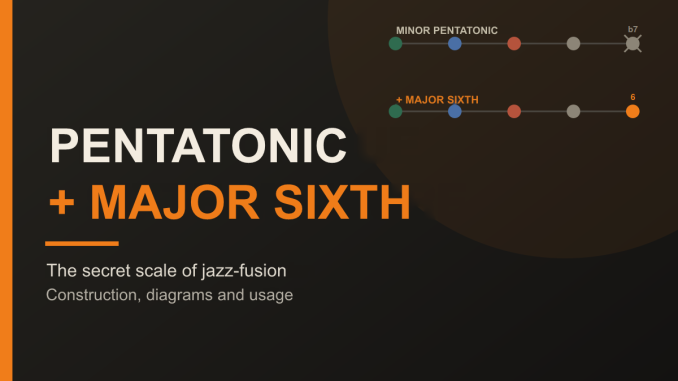
By replacing the minor seventh with a major sixth in a pentatonic scale, we get a modal pentatonic with a Dorian flavor, very useful for improvising off the beaten track.
This “modal” minor scale is used by many jazz/fusion guitarists, including Robben Ford, Larry Carlton and John Scofield.
Learning this modified scale will be very useful if you want to start improvising with modes, or simply to change the sound of your minor pentatonic solos a little.
How do you build this pentatonic/Dorian scale?
As you can see below, the minor pentatonic scale shares all its notes with the Dorian mode in the same key.
- minor pentatonic (G):
I – G | min III – Bb | IV – C | V – D | min VII – F
- Dorian mode, also in the key of G:
I – G | maj II – A | min III – Bb | IV – C | V – D | maj VI – E | min VII – F
So all you need to do is replace the last note of the minor pentatonic, a minor seventh (F in the key of G), with the major sixth (E) of the Dorian mode in G to get our “modal” pentatonic scale.
- minor pentatonic scale + major VI:
I – G | min III – Bb | IV – C | V – D | maj VI – E
Here are the five shapes to learn so you can then start working them into your improvisations.

Link to the tool: https://guitar-trainer.fr/scales.php
A good habit for starting to work this color into your solos: take a minor pentatonic lick you already know by heart, then simply replace the minor seventh with this major sixth whenever it comes up. It’s often the quickest way to hear the difference without rebuilding everything from scratch.
Of course, the exercise is available in the guitar-trainer.fr exercise generator so you can add this scale to your daily practice routine:
Leave a Reply
You must be logged in to post a comment.