
When you’re starting out, you usually learn chord shapes: you put your fingers where you’re told, and it sounds good. It’s an excellent way to start, but at some point, understanding why those notes work together changes everything. You can then transpose a chord anywhere on the neck, work out the shape of a chord you don’t know yet, or improvise an accompaniment without needing a chord chart.
This article doesn’t add any new shapes to memorize: it explains the recipe behind the chords you already play.
The basic building block: the major scale
All chords are built from the same reference: the major scale. It has 7 notes (the 7 “degrees”), and each chord is defined as a combination of some of these degrees.
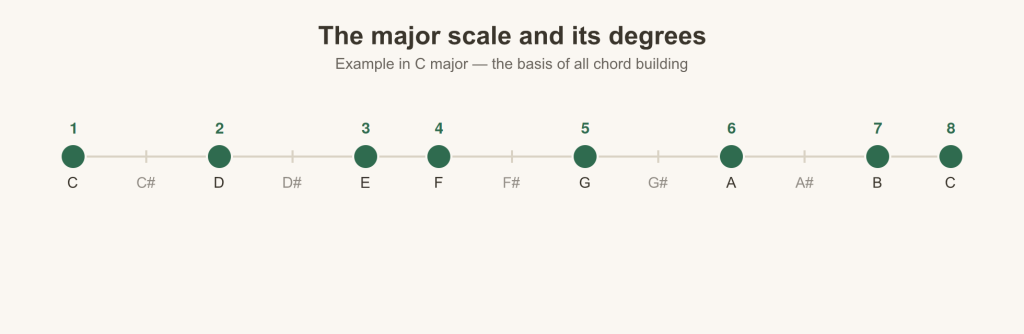
In this article, we’ll use the full chromatic scale (12 half steps) as a ruler: it lets you measure precisely the distance between the notes of a chord, whatever the key.
Anatomy of a chord: the triad
A basic chord (a “triad”) is made up of three notes:
- The root (degree 1): the note that gives the chord its name.
- The third (degree 3): it determines whether the chord sounds “major” or “minor”.
- The fifth (degree 5): it stabilizes the chord and rarely changes.
The entire difference between a major chord and a minor chord comes down to a single half step, on the third. That’s the secret many beginners don’t know.
The major chord: 1 – 3 – 5
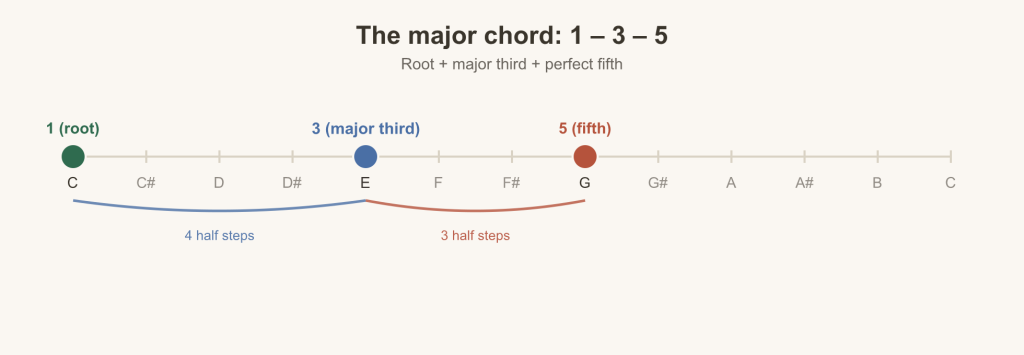
A major chord combines the root with a major third (4 half steps above) and a perfect fifth (7 half steps above). It’s this wide third that gives the chord its bright, “happy” color.
Example: C major = C (1) + E (3) + G (5).
The minor chord: 1 – ♭3 – 5
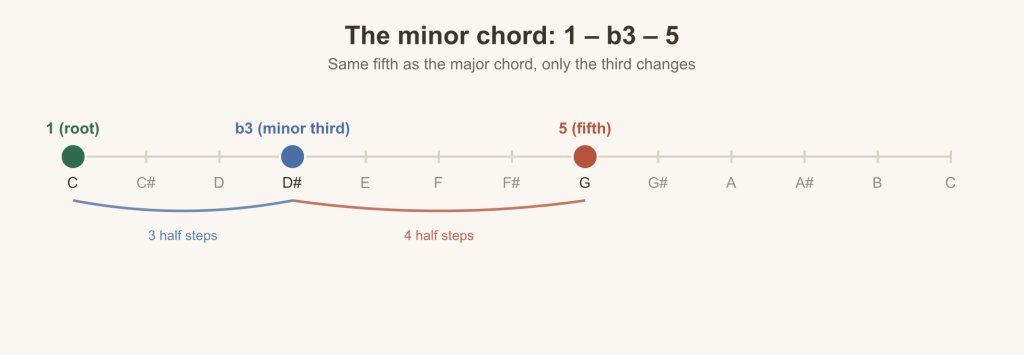
To get a minor chord, you lower the third by a half step: it goes from 4 to 3 half steps above the root. The fifth doesn’t move. It’s that one half step less that gives the chord its darker, more melancholy color.
Example: C minor = C (1) + E♭ (♭3) + G (5).
Key takeaway: if you know the major version of a chord, you already know 90% of its minor version: there’s only one note left to move down one fret (a half step).
Adding color: seventh chords
Once the triad is in place, you can add a fourth note: the seventh. It’s what gives chords that richer, more “jazzy” or more tense color you hear in so many songs.
The dominant seventh (7)

It’s the most common one in pop, blues and rock: you start from a major chord and add a minor seventh (10 half steps above the root). It creates a tension that “wants” to resolve to another chord; that’s exactly the tension you hear when a G7-type chord resolves down to C major.
Major seventh vs minor seventh
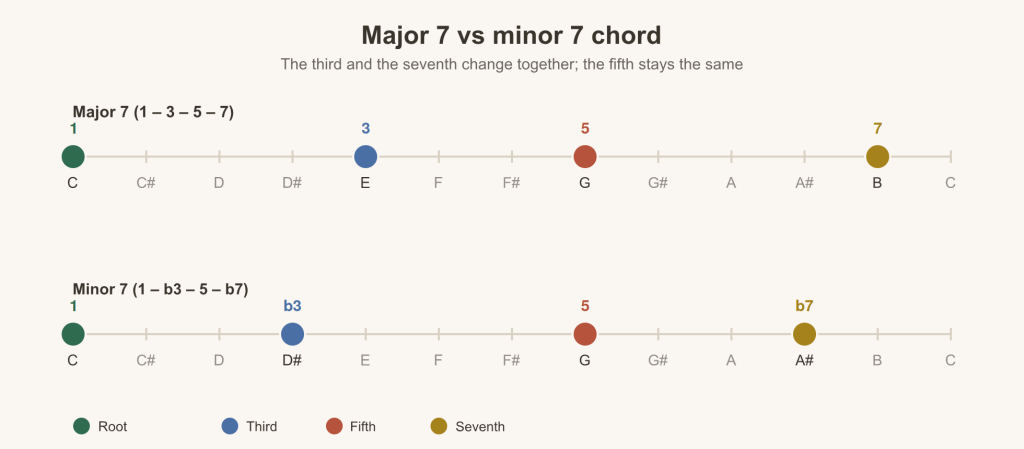
There are also seventh chords built on a minor triad, or with a “major” seventh (11 half steps, closer to the octave). The formulas can be summed up as follows:
- Major 7 (Maj7): 1 – 3 – 5 – 7 → soft, floating color.
- Minor 7 (m7): 1 – ♭3 – 5 – ♭7 → a softened minor color, less sad than a plain minor.
- Dominant 7 (7): 1 – 3 – 5 – ♭7 → tense color, pulling toward resolution.
How to use all this on your guitar
You don’t need to recount the half steps every time you play: the point of these formulas is to give you a framework for understanding, not a new real-time calculation method.
- When you learn a new chord shape, try to identify which of its notes is the root, the third and the fifth.
- If a major chord is giving you trouble, see what happens when you lower the third by one fret: you’ll often get the corresponding minor chord without changing the whole shape.
- To recognize a dominant 7 chord by ear, listen for that particular tension that “calls for” a resolution chord.
If you want to see these intervals directly on a fretboard and hear the difference between a major and a minor third, you can explore them with the Guitar-Trainer tools, which display the degrees of every chord or scale on the fretboard in real time.
Leave a Reply
You must be logged in to post a comment.