The 5 minor pentatonic positions and the m7 arpeggio (A minor)★

 | Recommended tempo: 60 bpm
|
Instructions
The minor pentatonic is the most played scale on guitar, but we often forget what it contains: the arpeggio of the minor seventh (m7) chord. In A minor:
- A minor pentatonic: A C D E G (1 – ♭3 – 4 – 5 – ♭7)
- Am7 arpeggio: A C E G (1 – ♭3 – 5 – ♭7)
So the pentatonic is the m7 arpeggio plus the fourth (D). In each of the 5 positions, if you remove the D notes (grey on the diagrams), you are left with the Am7 arpeggio in that area of the neck.
The link with harmonization. The A natural minor scale (A B C D E F G) harmonized in seventh chords gives: Am7 – Bm7♭5 – Cmaj7 – Dm7 – Em7 – Fmaj7 – G7. The pentatonic is exactly this scale without B and F. What this means for the arpeggios of the 7 chords:
- Am7 (i) is entirely inside the pentatonic;
- Cmaj7 (♭III) and Em7 (v) only need B added;
- Dm7 (iv) and Fmaj7 (♭VI) only need F added;
- G7 (♭VII) and Bm7♭5 (ii°) need both.
So the pentatonic already contains 3 out of 4 notes of most chords of the harmonized scale: that is why it "works" over a whole progression in A minor. And by adding B or F at the right moment, you make the exact chord heard instead of just the overall colour.
- Diagrams 1: the 5 positions, with the root (1), minor third (♭3), fifth (5) and minor seventh (♭7) in colour and the fourth (4) in grey. The last diagram shows the Am7 arpeggio over the whole neck. Position 5 (frets 14 to 17) can also be played an octave lower, frets 2 to 5.
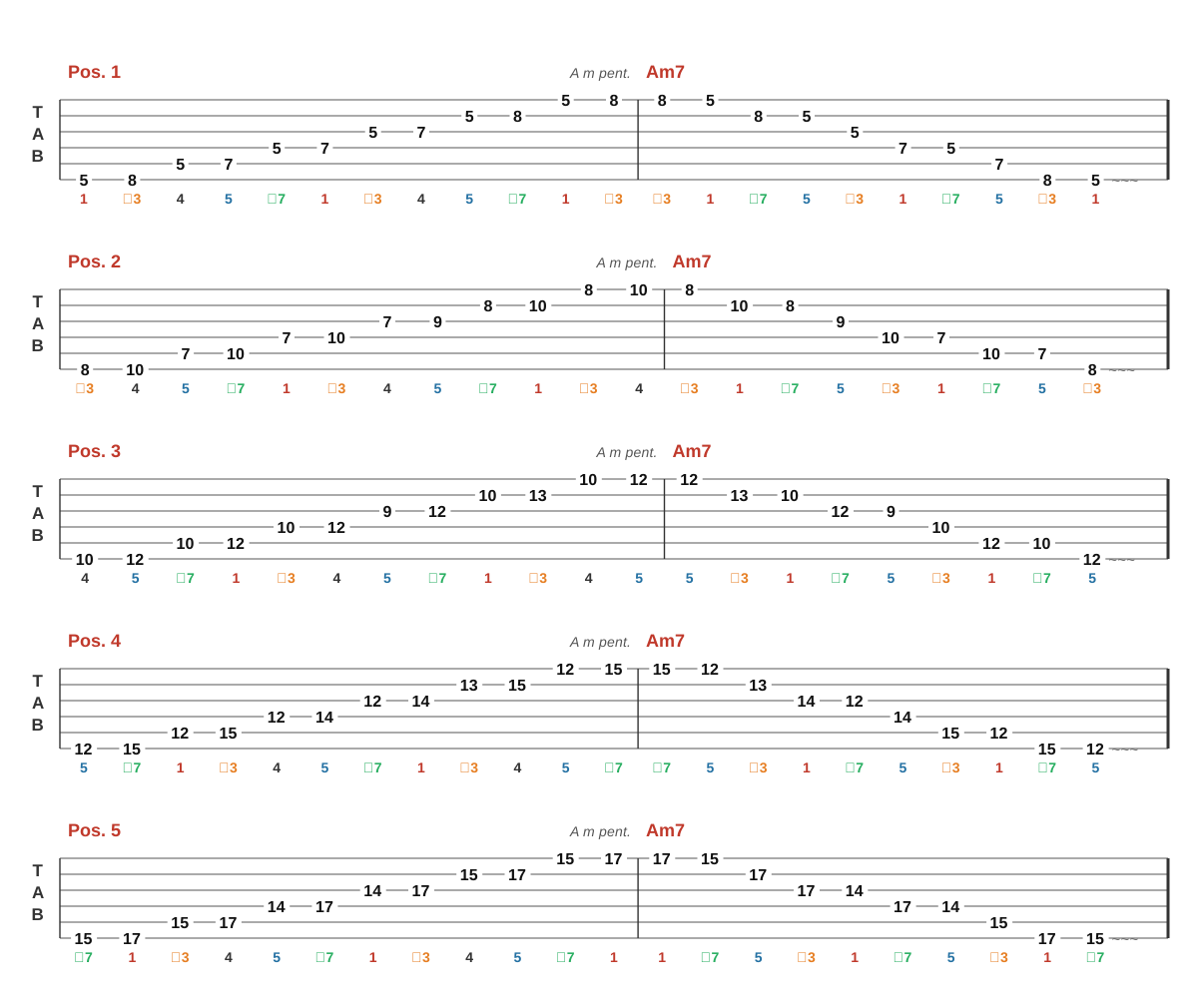
- Tab: for each position, play the scale up, then the Am7 arpeggio back down without leaving the position. The function of each note is shown below the tab.
- Diagrams 2: the arpeggios of the 7 chords of the harmonized A minor scale, in the same area as position 1 (frets 4 to 8). Filled notes are in the pentatonic, circled notes (B and F) are the ones to add. The last diagram shows the full scale: pentatonic + B + F.
Tips: work on one position at a time, slowly and with the metronome. Once the arpeggio is comfortable, improvise in that position, aiming for chord tones on the strong beats and using the D as a passing note. To connect it with harmonization, play each arpeggio from diagram 2 right after the pentatonic and spot the common notes. Then move on to the next step: three minor pentatonics for the harmonized minor scale.
Exercice 1
The 5 positions of the A minor pentatonic: Am7 chord tones in colour, the fourth (D) in grey.

Exercice 2
For each position: the scale going up, then the Am7 arpeggio coming down, without changing position.
Exercice 3
The 7 arpeggios of the harmonized A minor scale in position V: filled notes = in the pentatonic, circled notes = B and F to add.
