Three minor pentatonics for the harmonized minor scale (A minor)★

 | Recommended tempo: 70 bpm
|
Instructions
This exercise follows “The 5 minor pentatonic positions and the m7 arpeggio”, where we saw that the A minor pentatonic contains the Am7 arpeggio. But Am7 is only one of the seven chords of the A minor scale harmonized in seventh chords:
- Am7 – Bm7♭5 – Cmaj7 – Dm7 – Em7 – Fmaj7 – G7 (i – ii° – ♭III – iv – v – ♭VI – ♭VII)
The three minor seventh chords (i, iv and v) each have their own minor pentatonic, and none of them contains a note outside the key:
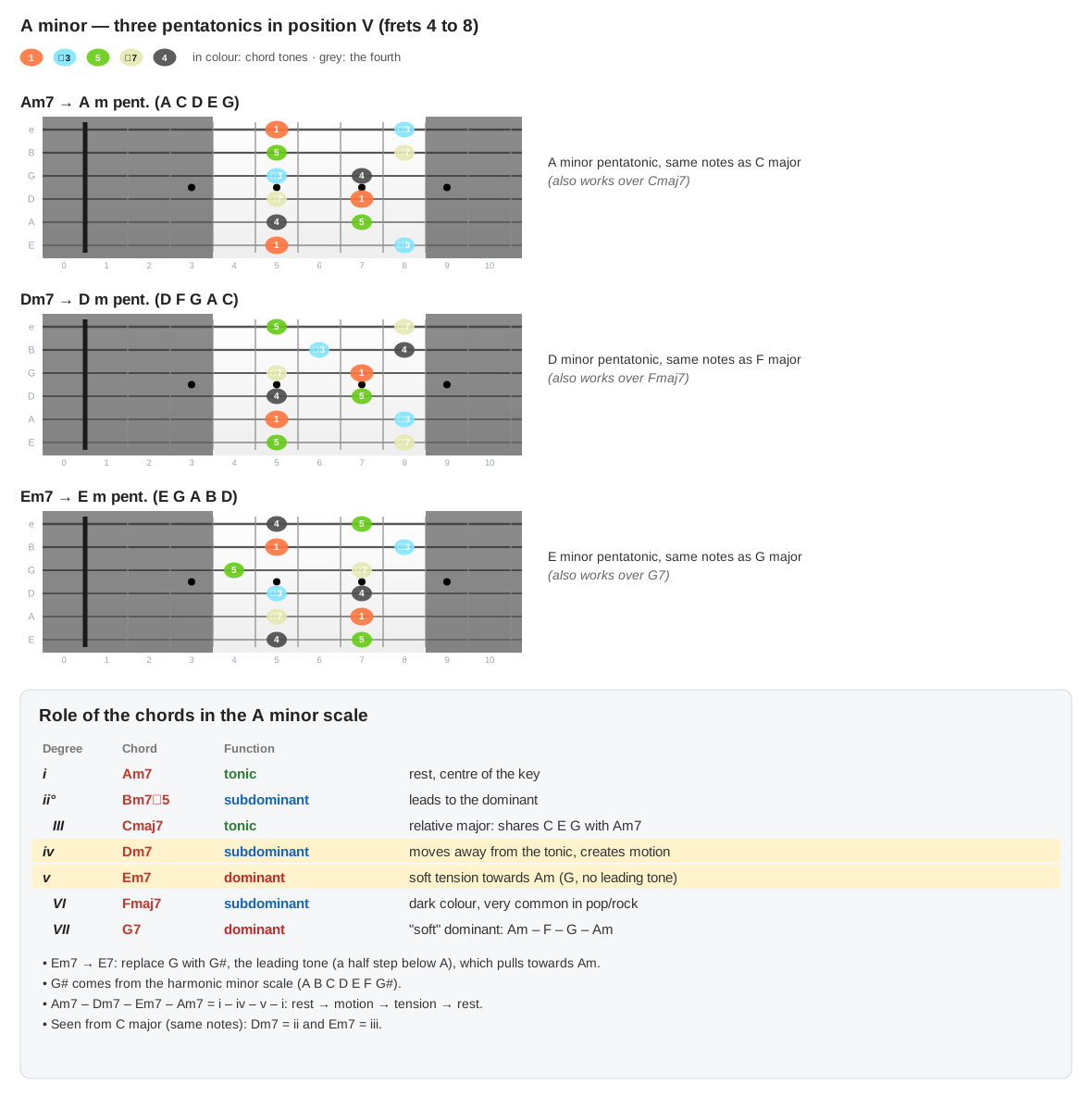
- over Am7: A minor pentatonic (A C D E G), which also works over Cmaj7 (it is the C major pentatonic);
- over Dm7: D minor pentatonic (D F G A C), which also works over Fmaj7 (F major pentatonic);
- over Em7: E minor pentatonic (E G A B D), which also works over G7 (G major pentatonic).
Together, these three pentatonics give back all 7 notes of A minor. With three shapes you already know, you can follow the chords instead of staying on a single pentatonic: each chord change brings in new notes (F over Dm7 and Fmaj7, B over Em7 and G7).
Everything is played in the same area of the neck (position V, frets 4 to 8), without moving your hand:
- Diagrams: the three pentatonics in position V. They all share the same structure: m7 arpeggio (in colour) + fourth (in grey). Below, a table sums up the role of each chord in the scale: tonic, subdominant or dominant (and why E7 is often played instead of Em7).
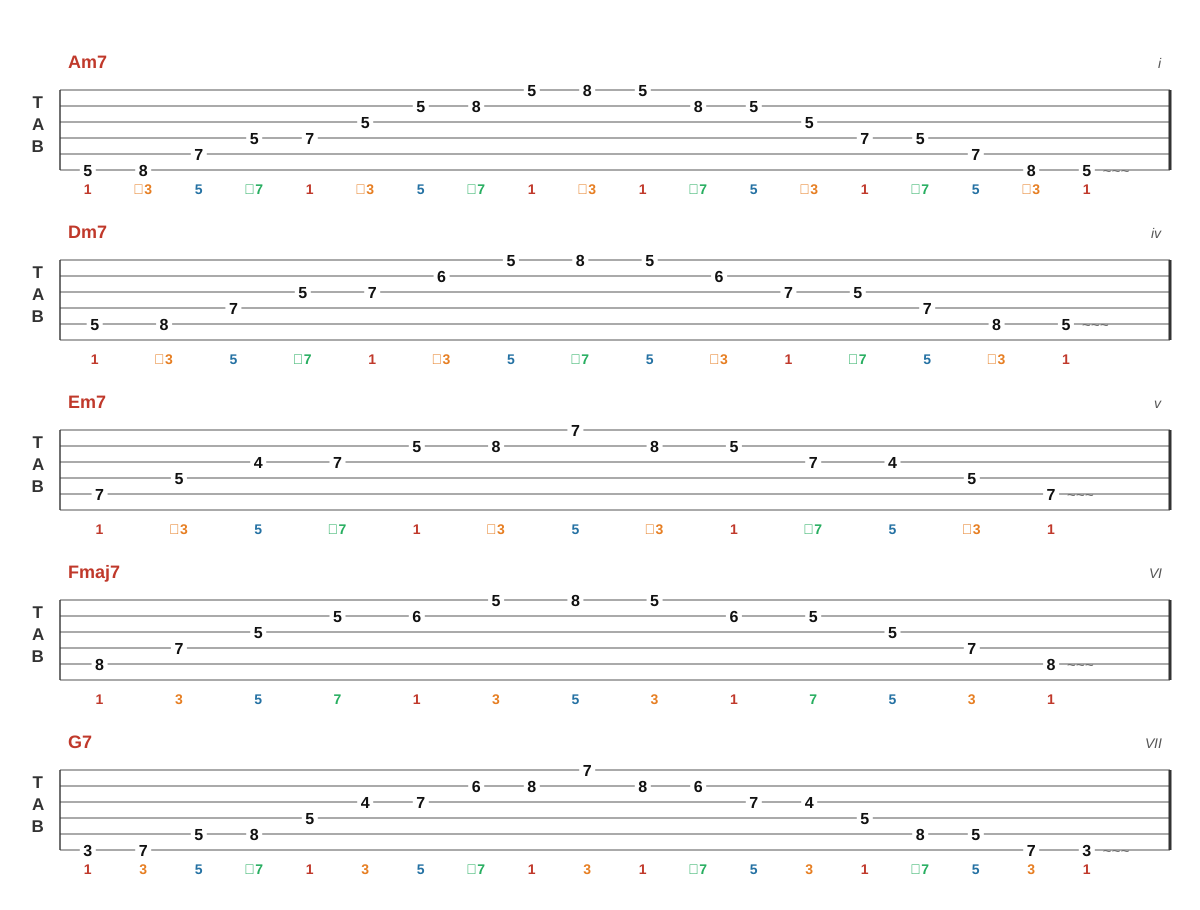
- Tab 1: the Am7, Dm7, Em7, Fmaj7 and G7 arpeggios in this position, up and down.
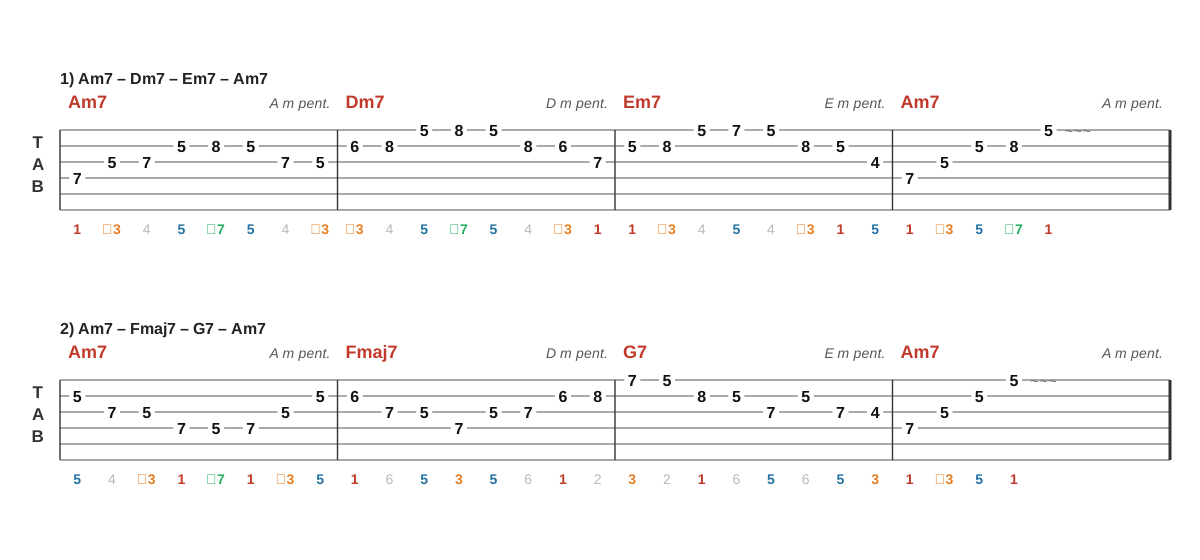
- Tab 2: two eighth-note phrases over Am7 – Dm7 – Em7 – Am7 and Am7 – Fmaj7 – G7 – Am7. Each bar uses the chord's pentatonic and starts on a chord tone; the number under each note gives its function in the current chord (grey: passing note). The last note rings.
Tips: learn the arpeggios first, then the two phrases with the metronome. Then record the progression (or play it with a friend) and improvise your own phrases, switching pentatonic on each chord and aiming for a chord tone (1, 3, 5 or 7) on the first beat of each bar.
Exercice 1
The A, D and E minor pentatonics in position V (in colour: Am7, Dm7 and Em7 chord tones), and the role of each chord in the scale.
Exercice 2
Arpeggios of the chords of the harmonized A minor scale in position V. Play up and down with the metronome.
Exercice 3
Two phrases: switch pentatonic on each chord and land on a chord tone on the first beat.