Jazz fusion improvisation over Sunny (Bobby Hebb): arpeggios and target notes in A minor★

 | Recommended tempo: 70 bpm
|
Instructions
"Sunny" (Bobby Hebb, 1966) is one of the most played charts at jazz and fusion jams, usually in A minor. It is short, it loops, and each chord brings a different colour: the ideal ground to learn to improvise over the chords rather than over a single scale.
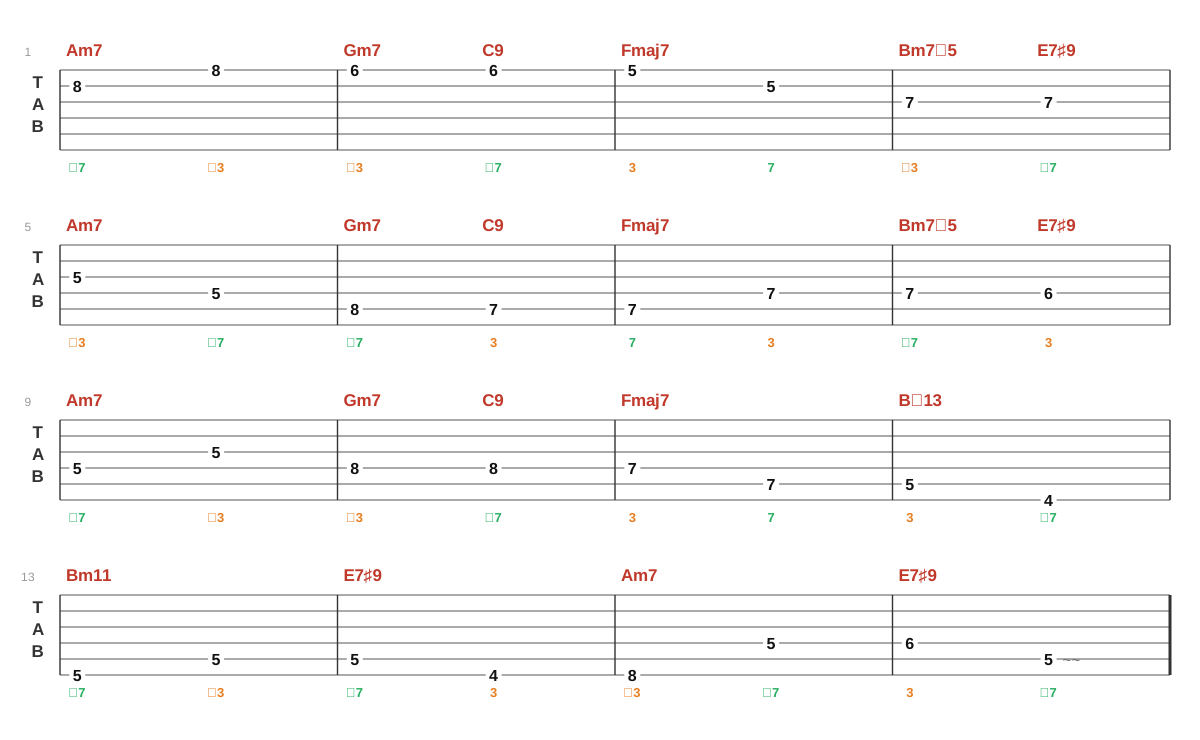
The chart (16 bars): Am7 | Gm7 C9 | Fmaj7 | Bm7♭5 E7♯9 (twice), then Am7 | Gm7 C9 | Fmaj7 | B♭13, and Bm11 | E7♯9 | Am7 | E7♯9.
- Am7 (i): the tonic chord.
- Gm7 – C9: a ii – V leading to Fmaj7. The B♭ (third of Gm7, seventh of C9) falls to the A of Fmaj7, and the E of C9 rises to F.
- Fmaj7 (♭VI): the 6th degree of A minor.
- Bm7♭5 – E7♯9: the minor ii – V back to Am. Bm7♭5 is the 2nd degree of harmonized A minor, with no outside note. The G# in E7♯9 is the leading tone, and its ♯9 is a G natural, the ♭3 of A minor: that is why the "Hendrix chord" sounds so good with the A minor pentatonic.
- B♭13 (bar 12): the tritone substitute for E7. Both chords share the same tritone (D and A♭/G#), and its 13 is a G.
- Bm11 – E7♯9 – Am7 – E7♯9: a ii – V – i followed by a turnaround to loop. Bm11 brings F# (Dorian colour) and E (the 11).
Why the pentatonic is not enough. The notes outside A natural minor (B♭ in Gm7, C9 and B♭13, G#/A♭ in E7♯9 and B♭13, F# in Bm11) are the ones that make the chord changes heard. A solo using only the A minor pentatonic sounds blues-rock: the jazz fusion sound comes from those notes, played at the right moment. See also “Three minor pentatonics for the harmonized minor scale”, played in the same area of the neck.
The method: arpeggios, tensions and target notes. The notes that best define a chord are its third and its seventh. From one chord to the next they barely move (a common tone, a half step or a whole step). By aiming for them on the first beat of each change, your phrase follows the chart. The tensions (the 9 of C9, the ♯9 of E7♯9, the 13 of B♭13, the 11 of Bm11) are built into the arpeggios: they give the fusion colour.
Everything is played in position V (frets 4 to 8):
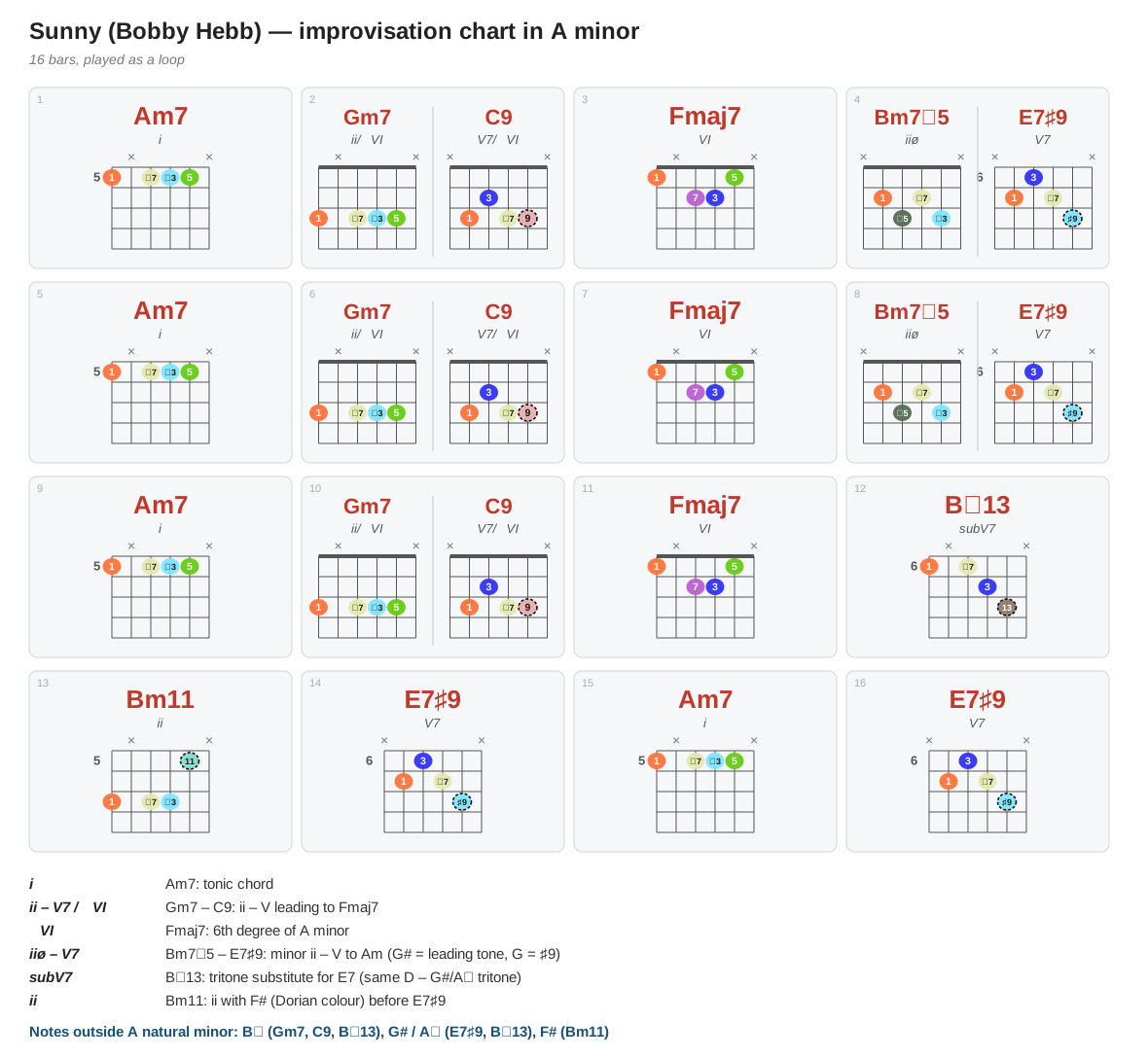
- Image 1: the chart, with the degree and a voicing diagram for each chord.
- Image 2: the arpeggios on the neck, with the same rendering as the interactive fretboard. Tensions are circled with a dashed line.
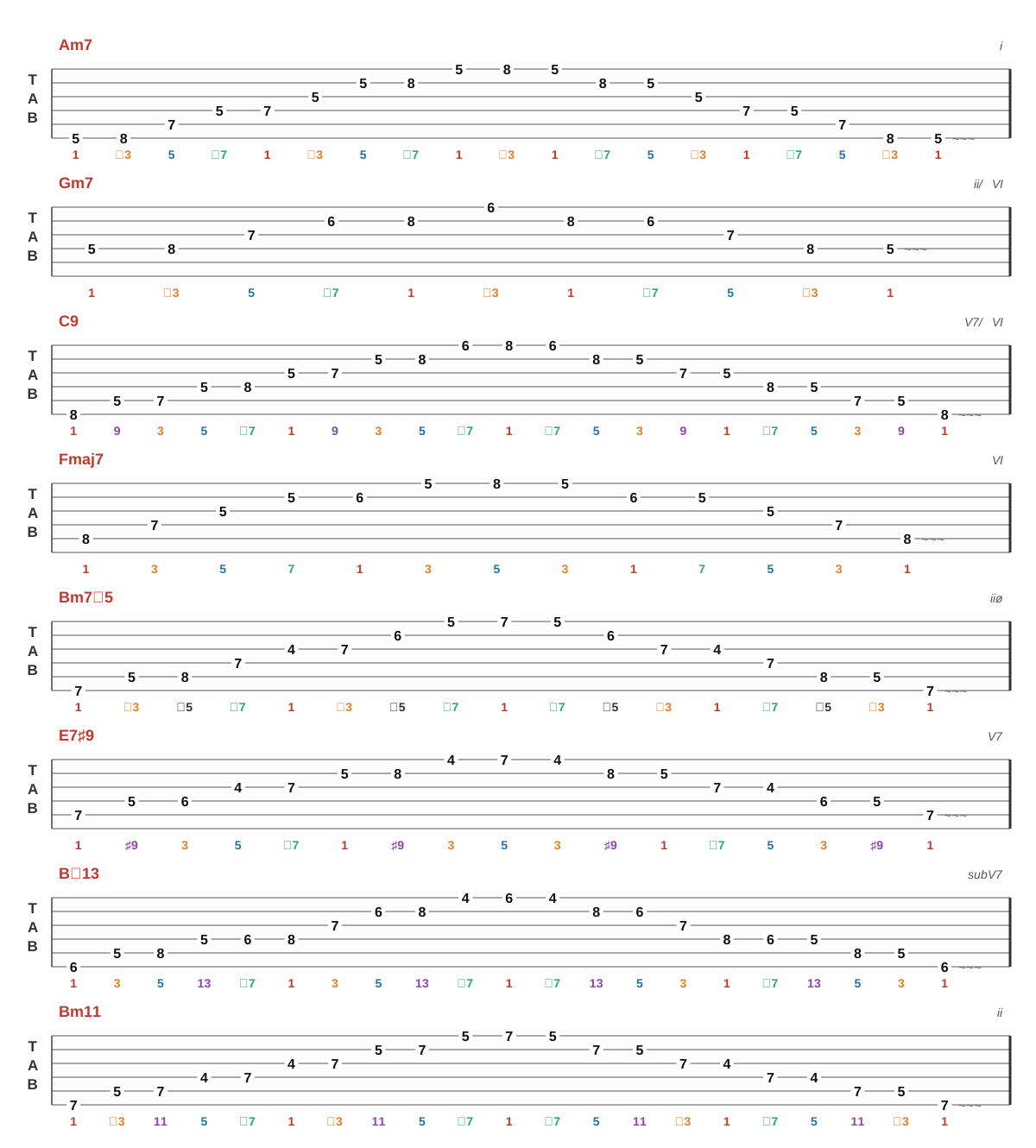
- Tab 1: each arpeggio, tension included, up and down (tensions in purple below the tab).
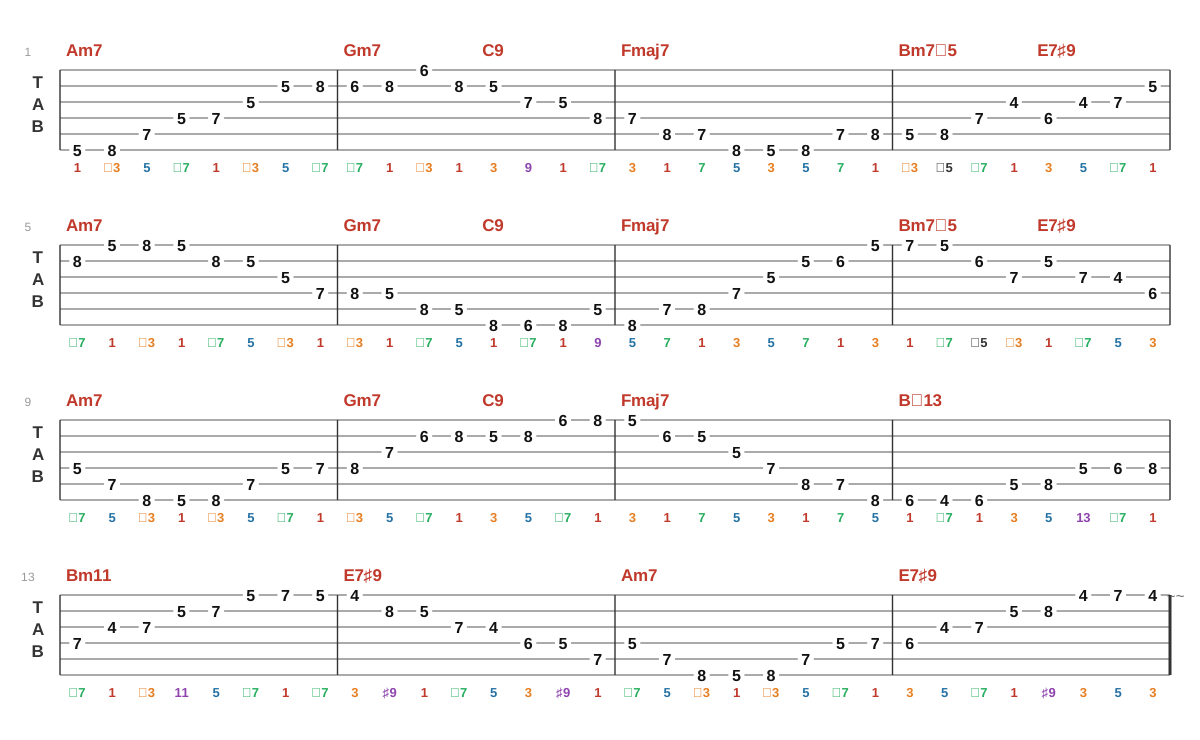
- Tab 2: the whole chart in eighth notes. Each chord starts on the arpeggio note closest to the previous note, so the chords connect without jumps.
- Tab 3: the target-note line, thirds and sevenths only, each one closest to the previous. It is the skeleton of your solos.
Suggested steps: 1) the arpeggios separately; 2) tab 2, slowly (60 to 70 bpm); 3) the target-note line over a backing track, until you can hear it without the tab; 4) improvise: A minor pentatonic over Am7 and E7♯9, and at every other change land on the chord's target note. For the fusion colour, approach the target note by a half step (the note just below or above) before playing it.
Exercice 1
The Sunny chart in A minor: degree and voicing diagram for each chord.
Exercice 2
The arpeggios of the chart in position V (interactive fretboard rendering), tensions circled with a dashed line.

Exercice 3
Each arpeggio in position V, tension included, up and down. Slowly, with the metronome.
Exercice 4
The whole chart in eighth notes: each chord starts on the note closest to the previous one.
Exercice 5
The target-note line (thirds and sevenths): aim for these notes on the first beat of each change.