Major scale for beginners: how it is built, what it is for and the 5 positions (C major)★

 | Recommended tempo: 60 bpm
|
Instructions
The major scale is the first scale to know on guitar. Here is how it is built, what it is used for and how to learn it, with its 5 positions in C.
How is the major scale built?
A major scale is 7 notes separated by a fixed pattern of whole steps (W) and half steps (H):
W - W - H - W - W - W - H
On guitar it is very simple: a half step = one fret, a whole step = two frets. Starting from C on the A string, 3rd fret, you get C major on a single string:
e|-------------------------|
B|-------------------------|
G|-------------------------|
D|-------------------------|
A|-3--5--7--8--10-12-14-15-|
E|-------------------------|
   C  D  E  F  G  A  B  C
    T  T  ½  T  T  T  ½
(T = whole step, ½ = half step.) The notes of C major are C D E F G A B: only natural notes, no sharps or flats. The two half steps fall between E and F, and between B and C. The notes are numbered from 1 to 7: these are the degrees (1 = C, the tonic, 3 = E, 5 = G...).
The same formula works from any note: start on G, apply W-W-H-W-W-W-H, and you get G major.
What is the major scale used for?
- Melodies: a huge number of songs you know (nursery rhymes, pop songs) use only the notes of a major scale.
- Chords: the chords of a key are built from its notes. In C major: C, Dm, Em, F, G, Am and Bdim. The famous C - G - Am - F progression is one of them.
- Improvisation: over a song in C major, every note of the scale sounds right. It is the starting point for improvising.
- Everything else: minor scales, modes, arpeggios and pentatonics are all understood from the major scale.
How to learn it (beginners)
- Start with one octave in open position (exercise below), saying the name of each note out loud.
- One finger per fret: index for fret 1, middle finger for fret 2, ring finger for fret 3. Keep your fingers close to the strings.
- Play with a metronome: 60 bpm, one note per beat, up then down. Move to two notes per beat when it feels smooth.
- Alternate picking: down, up, down, up, right from the start.
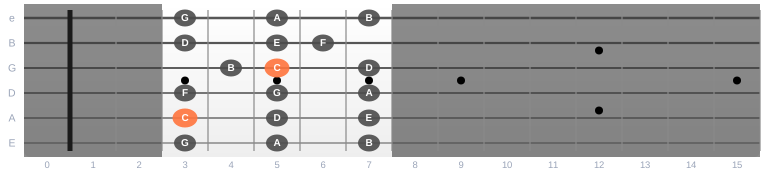
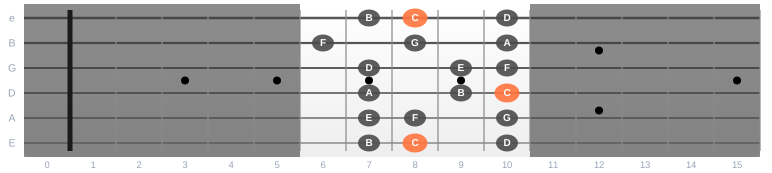
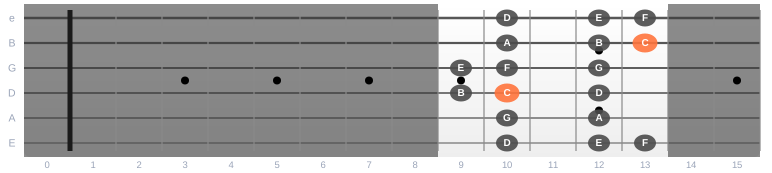
- Learn the positions one at a time: one position a week is enough. Always spot where the Cs are (in orange on the diagrams).
- Make music with it: record the C - G - Am - F progression and improvise over it with the notes of the position you know, ending your phrases on a C.
Starting exercise: one octave of C major in open position
e|-------------------------|-------------------------|
B|-------------------0--1--|-1--0--------------------|
G|-------------0--2--------|-------2--0--------------|
D|----0--2--3--------------|-------------3--2--0-----|
A|-3-----------------------|----------------------3--|
E|-------------------------|-------------------------|
   C  D  E  F  G  A  B  C  | C  B  A  G  F  E  D  C
Then the whole of position 1, from the lowest note (open low E) to the highest (G, 3rd fret of the high E string), up then down:
e|-------------------------|-------------------0--1--3--|
B|-------------------------|----------0--1--3-----------|
G|-------------------------|----0--2--------------------|
D|-------------------0--2--|-3--------------------------|
A|----------0--2--3--------|----------------------------|
E|-0--1--3-----------------|----------------------------|
The 5 positions of C major
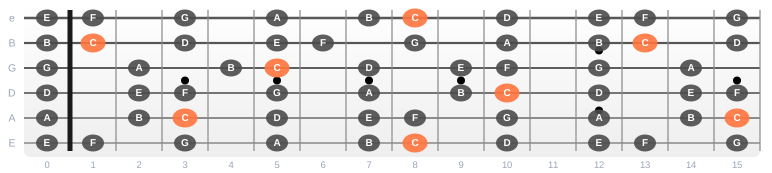
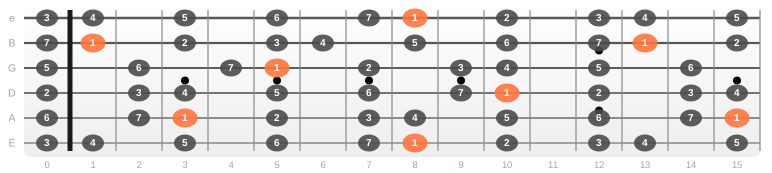
The diagrams below show the C major scale across the whole neck, as notes then as degrees, then split into 5 positions of 4 to 5 frets each. In orange: the Cs. To display and hear them, open them in the interactive fretboard (pick the position below the neck).
To train your ear on these notes too, try level 1 of Perfect Pitch: it uses exactly the notes of C major.
Exercice 1
C major across the whole neck (frets 0 to 15). In orange: the Cs. All the notes are natural (C D E F G A B).
Exercice 2
The same scale as degrees: 1 = C, 2 = D, 3 = E, 4 = F, 5 = G, 6 = A, 7 = B. The half steps are between 3 and 4, and between 7 and 1.
Exercice 3
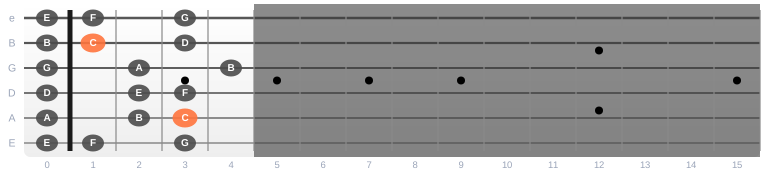
Position 1 (frets 0 to 4): the open position, the easiest one to start with. Open strings included.
Exercice 4
Position 2 (frets 3 to 7).
Exercice 5
Position 3 (frets 6 to 10): a widely used position, around the C at the 8th fret (low E string).
Exercice 6
Position 4 (frets 9 to 13).
Exercice 7
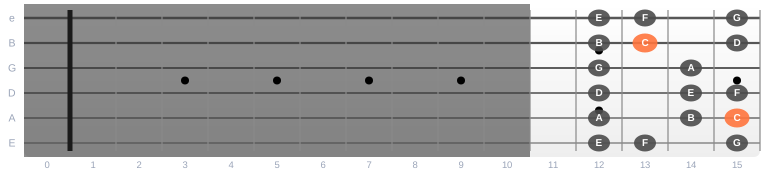
Position 5 (frets 11 to 15): it joins position 1, one octave higher (fret 12 = fret 0).