Minor scale for beginners: how it is built, what it is for and the 5 positions (A minor)★

 | Recommended tempo: 60 bpm
|
Instructions
The minor scale (natural minor) is the second scale to know on guitar, right after the major scale. Here is how it is built, what it is used for and how to learn it, with its 5 positions in A minor.
How is the minor scale built?
Like the major scale, a natural minor scale has 7 notes separated by a fixed pattern of whole steps (W) and half steps (H), but in a different order:
W - H - W - W - H - W - W
On guitar: a half step = one fret, a whole step = two frets. Starting from the open A string, you get A minor on a single string:
e|-------------------------|
B|-------------------------|
G|-------------------------|
D|-------------------------|
A|-0--2--3--5--7--8--10-12-|
E|-------------------------|
   A  B  C  D  E  F  G  A
    T  ½  T  T  ½  T  T
(T = whole step, ½ = half step.) The notes of A minor are A B C D E F G: only natural notes, just like C major! A minor is the relative minor of C major: both scales have exactly the same notes, but A minor starts on A and revolves around it. If you already know the C major scale, you already know the A minor fingerings: only the tonic (in orange) changes.
As degrees, the minor scale is 1 - 2 - ♭3 - 4 - 5 - ♭6 - ♭7. Compared with the major scale (1 2 3 4 5 6 7), the 3rd, 6th and 7th are lowered by a half step: it is mainly the minor third (♭3) that gives minor its sad or dark color.
The same formula works from any note: start on E, apply W-H-W-W-H-W-W, and you get E minor.
What is the minor scale used for?
- Melodies: many melancholic songs, ballads, rock and metal tunes are in minor.
- Chords: in A minor, the chords of the key are Am, Bdim, C, Dm, Em, F and G (the same as in C major, seen from A). The Am - F - C - G and Am - Dm - Em progressions are among them.
- Improvisation: over a song in A minor, every note of the scale sounds right. It is also the full scale that contains the minor pentatonic (the minor scale without the 2 and the ♭6).
- What comes next: the harmonic minor, the melodic minor and the Dorian and Phrygian modes are all understood from the natural minor.
How to learn it (beginners)
- Start with one octave in open position (exercise below), saying the name of each note out loud.
- One finger per fret: index for fret 1, middle finger for fret 2, ring finger for fret 3. Keep your fingers close to the strings.
- Play with a metronome: 60 bpm, one note per beat, up then down. Move to two notes per beat when it feels smooth.
- Alternate picking: down, up, down, up, right from the start.
- Learn the positions one at a time: one position a week is enough. Always spot where the As are (in orange on the diagrams): that is where the scale "comes to rest".
- Make music with it: record the Am - F - C - G progression and improvise over it with the notes of the position you know, ending your phrases on an A.
Starting exercise: one octave of A minor in open position
e|-------------------------|-------------------------|
B|-------------------------|-------------------------|
G|-------------------0--2--|-2--0--------------------|
D|----------0--2--3--------|-------3--2--0-----------|
A|-0--2--3-----------------|----------------3--2--0--|
E|-------------------------|-------------------------|
   A  B  C  D  E  F  G  A  | A  G  F  E  D  C  B  A
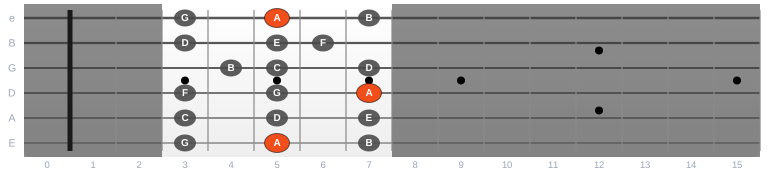
Then two octaves of A minor in position 2, around the A at the 5th fret (low E string), the most used area for improvising in A minor. Go up from the low A to the high A (5th fret of the high E string), then back down:
e|-------------------------|----------------3--5--|
B|-------------------------|----------5--6--------|
G|-------------------------|-4--5--7--------------|
D|----------------3--5--7--|----------------------|
A|-------3--5--7-----------|----------------------|
E|-5--7--------------------|----------------------|
   A  B  C  D  E  F  G  A  | B  C  D  E  F  G  A
The 5 positions of A minor
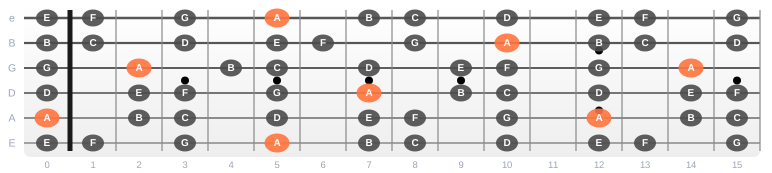
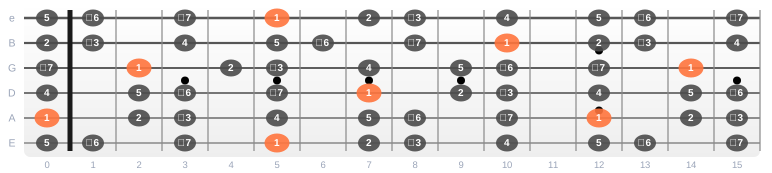
The diagrams below show the A minor scale across the whole neck, as notes then as degrees, then split into 5 positions of 4 to 5 frets each. In orange: the As. Compare with C major: the notes are the same, only the reference notes change. To display and hear them, open them in the interactive fretboard (pick the position below the neck).
To go further, work on the 3 pentatonics of the harmonized minor scale.
Exercice 1
A minor across the whole neck (frets 0 to 15). In orange: the As. All the notes are natural (A B C D E F G), the same as C major.
Exercice 2
The same scale as degrees: 1 = A, 2 = B, b3 = C, 4 = D, 5 = E, b6 = F, b7 = G. The half steps are between 2 and b3, and between 5 and b6.
Exercice 3
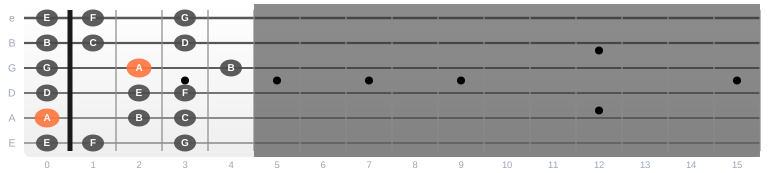
Position 1 (frets 0 to 4): the open position, with the open A string as the tonic. Open strings included.
Exercice 4
Position 2 (frets 3 to 7): the most used position in A minor, around the A at the 5th fret (low E string).
Exercice 5
Position 3 (frets 6 to 10): around the A at the 7th fret (D string).

Exercice 6
Position 4 (frets 9 to 13): around the A at the 12th fret (A string).

Exercice 7
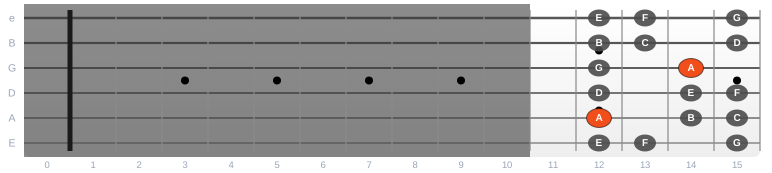
Position 5 (frets 11 to 15): it joins position 1, one octave higher (fret 12 = fret 0).