G arpeggios 7/11: G minor major 7 arpeggio (GmMaj7), 2 positions and horizontal playing★

 | Recommended tempo: 60 bpm
|
Instructions
G arpeggios, exercise 7/11: the G minor major 7 arpeggio (GmMaj7, also written G-7M). How it is built, what makes it different from the other arpeggios, what it is used for, and how to play it in 2 "vertical" positions and "horizontally".
An arpeggio is a chord whose notes are played one after the other. It is the best way to "draw" a chord when improvising: your playing becomes more open and melodic than with a scale played note by note.
The G arpeggio series
All the arpeggios in the series are in G, so you can clearly see what changes from one arpeggio to the next. This table is the same in every exercise: the arpeggio worked on here is in bold. Click another arpeggio to open its exercise.
| # | Arpeggio | Symbol | 1 | Third | Fifth | Seventh | Notes in G |
|---|---|---|---|---|---|---|---|
| 1 | G major | G | 1 | 3 | 5 | – | G B D |
| 2 | G minor | Gm | 1 | ♭3 | 5 | – | G B♭ D |
| 3 | G major 7 | Gmaj7 | 1 | 3 | 5 | 7 | G B D F♯ |
| 4 | G minor 7 | Gm7 | 1 | ♭3 | 5 | ♭7 | G B♭ D F |
| 5 | G dominant 7 | G7 | 1 | 3 | 5 | ♭7 | G B D F |
| 6 | G minor 7 flat 5 (half-diminished) | Gm7♭5 | 1 | ♭3 | ♭5 | ♭7 | G B♭ D♭ F |
| 7 | ▶ G minor major 7 | GmMaj7 | 1 | ♭3 | 5 | 7 | G B♭ D F♯ |
| 8 | G major 7 sharp 5 | Gmaj7♯5 | 1 | 3 | ♯5 | 7 | G B D♯ F♯ |
| 9 | G diminished 7 | G°7 | 1 | ♭3 | ♭5 | 6 | G B♭ D♭ E |
| 10 | G augmented | G+ | 1 | 3 | ♯5 | – | G B D♯ |
| 11 | G major 7 flat 5 | Gmaj7♭5 | 1 | 3 | ♭5 | 7 | G B D♭ F♯ |
How is the G minor major 7 arpeggio built?
Formula: 1 - ♭3 - 5 - 7, i.e. the notes G - B♭ - D - F♯. From the root (G):
- ♭3 = B♭: minor 3rd (3 frets above the root)
- 5 = D: perfect 5th (7 frets above the root)
- 7 = F♯: major 7th (11 frets above the root)
What changes: Compared with Gm7, only the 7th changes: it goes up a half step (F becomes F♯). Compared with Gmaj7, only the third changes (B♭ instead of B). It is a minor arpeggio with a major 7th.
It comes from harmonizing the melodic minor scale (and the harmonic minor): it is the chord on degree I.
What is it used for?
- Play over Gm(maj7) (G-7M): chord I of G melodic minor and G harmonic minor.
- A dark, mysterious color ("film noir", James Bond soundtracks).
- In the line Gm - Gm(maj7) - Gm7 - Gm6, it plays the note that descends chromatically.
How to practice it
- Start with the chord: each arpeggio position is built around a chord shape. Strum the chord, then play its notes one by one.
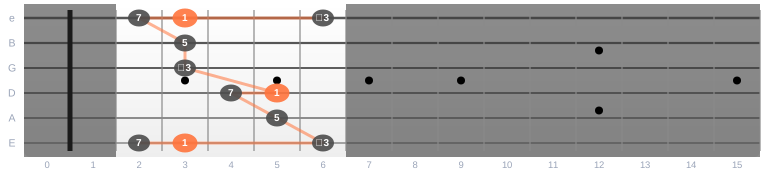
- Position 1 (vertical): root on the low E string, 3rd fret, between frets 2 and 6. Go up from the lowest note to the highest, then back down.
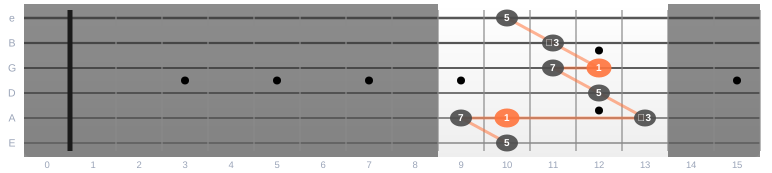
- Position 2 (vertical): root on the A string, 10th fret, between frets 9 and 13.
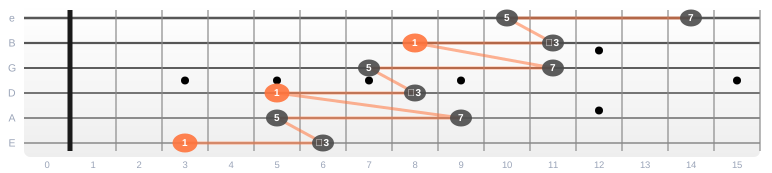
- Horizontal playing: the same arpeggio moving across the neck, from the 3rd fret upwards, to connect the two positions.
- Say the degrees (1, ♭3, 5, 7) out loud while playing: this is what lets you transpose to every key later.
- With a metronome: 60 bpm, two notes per beat, up and down, with alternate picking. Gradually work up to 90 bpm.
The 2 positions of the GmMaj7 chord
Position 1: root on the 6th string (3rd fret). Position 2: root on the 5th string (10th fret). x = string not played.
e|--x--|--x--|
B|--3--|--11-|
G|--3--|--11-|
D|--4--|--12-|
A|--x--|--10-|
E|--3--|--x--|
  pos.1  pos.2
Position 1, "vertical" (frets 2 to 6)
e|-------------------------2--3--6--|-6--3--2--------------------------|
B|----------------------3-----------|----------3-----------------------|
G|-------------------3--------------|-------------3--------------------|
D|-------------4--5-----------------|----------------5--4--------------|
A|----------5-----------------------|----------------------5-----------|
E|-2--3--6--------------------------|-------------------------6--3--2--|
   7  1  b3 5  7  1  b3 5  7  1  b3 |  b3 1  7  5  b3 1  7  5  b3 1  7
Position 2, "vertical" (frets 9 to 13)
e|-------------------------10-|-10-------------------------|
B|----------------------11----|----11----------------------|
G|----------------11-12-------|-------12-11----------------|
D|-------------12-------------|-------------12-------------|
A|----9--10-13----------------|----------------13-10-9-----|
E|-10-------------------------|-------------------------10-|
   5  7  1  b3 5  7  1  b3 5  |  5  b3 1  7  5  b3 1  7  5
Arpeggio played "horizontally"
Two notes per string: the shape repeats as you go up, which makes it easy to memorize.
e|-------------------------------10-14-|-14-10-------------------------------|
B|-------------------------8--11-------|-------11-8--------------------------|
G|-------------------7--11-------------|-------------11-7--------------------|
D|-------------5--8--------------------|-------------------8--5--------------|
A|-------5--9--------------------------|-------------------------9--5--------|
E|-3--6--------------------------------|-------------------------------6--3--|
   1  b3 5  7  1  b3 5  7  1  b3 5  7  |  7  5  b3 1  7  5  b3 1  7  5  b3 1
The diagrams
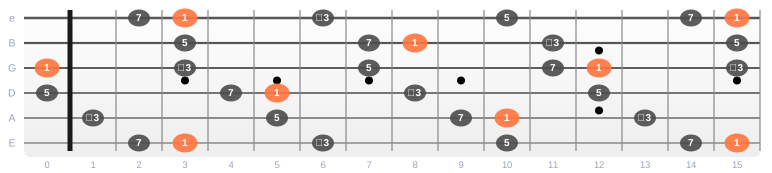
The diagrams below show the G minor major 7 arpeggio across the whole neck (as degrees then as notes), then the two vertical positions and the horizontal path. In orange: the Gs (the root). The line shows the order in which to play the notes. To display and hear them, open them in the interactive fretboard.
Exercice 1
G minor major 7 arpeggio (GmMaj7) across the whole neck, as degrees: 1 b3 5 7. In orange: the Gs (root).
Exercice 2
The same arpeggio as notes: G Bb D F#.

Exercice 3
Position 1, vertical (frets 2 to 6), root on the low E string, 3rd fret. The line shows the order of the notes.
Exercice 4
Position 2, vertical (frets 9 to 13), root on the A string, 10th fret.
Exercice 5
Arpeggio played horizontally, from the 3rd fret upwards: it connects the two positions.