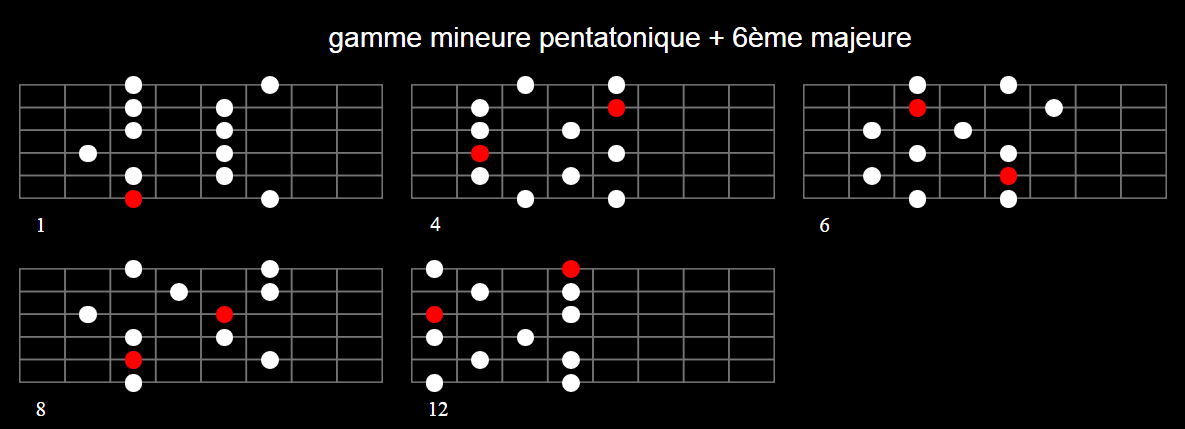
G minor pentatonic + major 6th

 | Tempo recommandé : 60 bpm
Instructions
Instructions: The "Modal" Pentatonic
By replacing the minor seventh with a major sixth in a pentatonic scale, we get a modal pentatonic with a Dorian sound. This approach is very useful for improvising off the beaten path.
This "modal" minor scale is used by jazz/fusion guitarists, including Robben Ford, Larry Carlton and John Scofield.
As you can see below, the minor pentatonic scale shares all its notes with the Dorian mode in the same key:
Structure comparison (Example in G)
Minor PENTATONIC (G):
I (G) - bIII (Bb) - IV (C) - V (D) - bVII (F)
DORIAN mode (G):
I (G) - II (A) - bIII (Bb) - IV (C) - V (D) - VI (E) - bVII (F)
So all you need to do is replace the minor seventh (F) with the major sixth (E) of the Dorian mode to get our "modal" pentatonic scale.
Minor PENTATONIC 6 (G):
I (G) - bIII (Bb) - IV (C) - V (D) - VI (E)
Practice and application
Here are the five shapes you'll need to learn so you can then use them in your improvisations and solos.
Note: the demo video - which is in the key of A, unlike the diagrams above which are in G - will let you hear the sound of this scale in a blues context.
It's taken from the "Blues Guitar Universe" website, which I invite you to visit!
Exercice 1
Learn the 5 positions of the G pentatonic + major 6th scale. Use the metronome and start slowly. Feel free to improvise over a backing track once you feel comfortable. In the video the guitarist plays in the key of A, so you'll need to shift the positions up two frets to go from the key of G to A.