
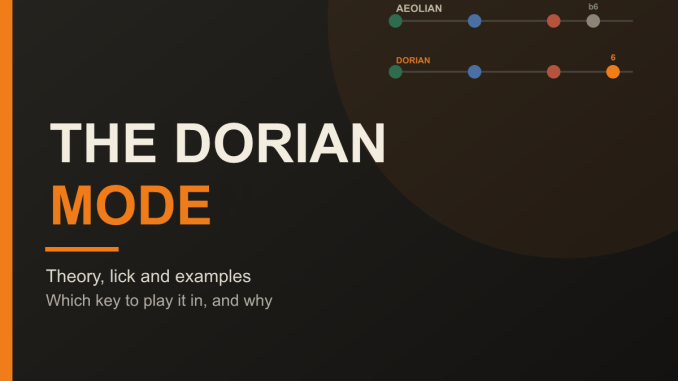
A quick theory reminder on the Dorian mode
This Dorian lick is, as you might guess, based on the Dorian mode. The Dorian mode shares almost all its notes with the widely used natural minor scale (also called the Aeolian mode; more on modes on Wikipedia, among others).
Here’s a table showing the intervals that make up the natural minor scale and the Dorian mode. All the intervals are identical except the sixth note, which is a minor sixth in the natural minor scale and a major sixth in the Dorian mode. That single note changes absolutely everything: it gives Dorian a minor but bright color, less dark than the natural minor scale.
Note also that the natural minor scale, the Dorian mode and the minor pentatonic scale share exactly the same notes, except for the second (absent from the pentatonic) and the sixth (absent from the pentatonic, minor in the natural minor scale, major in Dorian). So you just need to add the major second and a minor or major sixth to your usual minor pentatonic to get, respectively, the natural minor scale or the full Dorian mode.
|
natural minor scale (Aeolian mode) |
Dorian mode | minor pentatonic scale |
|---|---|---|
| I root | I root | I root |
| II major second | II major second | |
| bIII minor third | bIII minor third | bIII minor third |
| IV perfect fourth | IV perfect fourth | IV perfect fourth |
| V fifth | V fifth | V fifth |
| bVI minor sixth | VI major sixth | |
| bVII minor seventh | bVII minor seventh | bVII minor seventh |
Dorian, natural minor, pentatonic: what’s the difference to the ear?
On paper, only one note changes between these scales. To the ear, though, the difference is immediately noticeable as soon as you lean on that sixth a little:
- The minor pentatonic is the most neutral of the three: with no second or sixth, it “sounds right” in almost any minor context, but it’s also the least distinctive.
- The natural minor scale (Aeolian) adds a second and a minor sixth: it’s darker and more dramatic, and it’s the go-to scale in rock and metal for “classic” minor riffs and solos.
- The Dorian mode differs from Aeolian only by that major sixth. The result: a minor color that stays open, almost optimistic, widely used in modal jazz, funk, fusion and a good deal of progressive rock.
In practice, if you’re playing a minor phrase and want it to sound less “sad” or more sophisticated without turning major, replacing the minor sixth with a major sixth (i.e. playing Dorian rather than Aeolian) is often the quickest way to get there.
Why work on this Dorian lick?
This Dorian lick will help you soak up the sound of the Dorian mode, but also break your playing habits and build musical vocabulary to enrich your solos.

A good exercise is to practice this lick, then improvise over the minor pentatonic scale, the natural minor scale and the Dorian mode, playing with a metronome or, even more useful, improvising over a backing track like this one:
What key should you play this lick in?
The lick above is in B Dorian. To put it in context, remember that the Dorian mode always corresponds to the second degree of a major scale: B Dorian therefore uses exactly the same notes as the A major scale, but played and centered around B rather than A.
In practice, this means the lick will work naturally in the following contexts:
- Over a sustained or looped Bm7 (B minor 7) chord, typical of modal vamps in jazz, funk or fusion.
- Over a Bm7 → E7 progression (the famous i m7 → IV7, the quintessential Dorian progression heard for example in Pink Floyd’s Breathe, transposed here to B).
- As the IInd degree in a ii-V-I in A major (Bm7 – E7 – Amaj7), to bring a slightly different color from Aeolian over the ii chord.
To transpose this lick to another key, just find the major scale a whole step below your new Dorian root: for example, to play this lick in E Dorian, think of the D major scale, but center your phrases on E.
A few famous songs in the Dorian mode
To finish convincing you that this mode is worth a look, here are a few well-known examples that use it, across all styles:
- So What – Miles Davis (D Dorian): THE quintessential modal jazz tune, built entirely on this mode.
- Oye Como Va – Tito Puente / Carlos Santana (A Dorian): the Am7 – D7 loop is a textbook Dorian progression.
- Evil Ways – Carlos Santana (G Dorian): another classic where Santana makes heavy use of this mode in his solos.
- Breathe – Pink Floyd (E Dorian): the Em7 → A7 progression is another iconic example of the Dorian color.
- Eleanor Rigby – The Beatles (E Dorian): a pop example showing that Dorian isn’t reserved for jazz or progressive rock.
- Scarborough Fair – traditional / Simon & Garfunkel: a folk standard where the Dorian color creates that ancient, melancholy atmosphere.
If you want to go further with jazz, blues and fusion improvisation, you can also take a look at this article, which already covered mixing the pentatonic scale with the Dorian mode. You’ll find the diagrams for working on this mix of two particularly useful scales:
As usual, you’ll find this exercise in the practice routine generator on guitar-trainer.fr or directly at this address:
https://guitar-trainer.fr/exercice/lick/guitare/lick-dorien/exercises.php?id=46
Leave a Reply
You must be logged in to post a comment.