
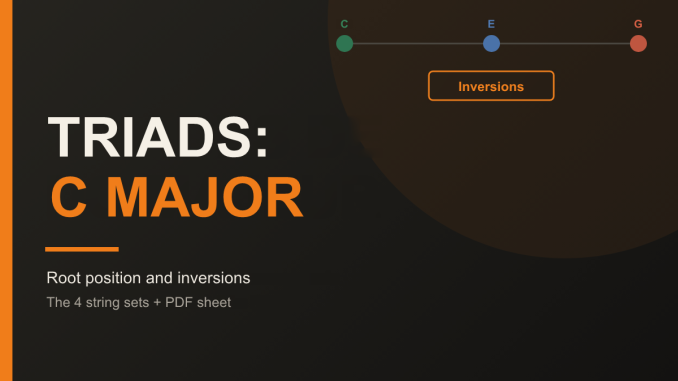
Triads are everywhere, triads are useful, but why?
Well, because they’ll help you learn the guitar fretboard and broaden your musical knowledge and composition skills.
In this article we’ll look at major triads (Root – Major third – Fifth). The other types of triads will be covered in other articles.
Visualizing C major triads and inversions on the fretboard
Major triads are nothing more than major chords, so they’re built from the same intervals as major chords: root, major third and fifth.
In the key of C, the notes will therefore be:
- C (“Do” in Latin notation)
- E (or “Mi”)
- G (or “Sol”)
In practice, here’s a diagram of the C major arpeggio generated with the tool available on Guitar-Trainer.
- Roots (red)
- Major thirds (blue)
- Fifths (green)

The idea is to learn the major triads starting from the G, D, A and E strings, along with the two possible inversions:
First inversion: E G C
Second inversion: G C E

To learn the notes on the neck and train your ear, it’s very useful to find the different shapes on the 4 low strings without looking at the tab. But here’s the tab if you need it, or just to give you a first overview.

Practice until moving through the triads becomes automatic. Once you’ve absorbed these positions, it’ll be very easy to work out the other keys. Again, a bit of work will be needed, but the hardest part is done.
I’ll write other articles on the same principle for minor and diminished triads.
Leave a Reply
You must be logged in to post a comment.