
Diagrams and exercises to master the major scale on guitar
Practicing scales has many benefits, but the main goal should be to memorize the sound and the mood each scale creates.
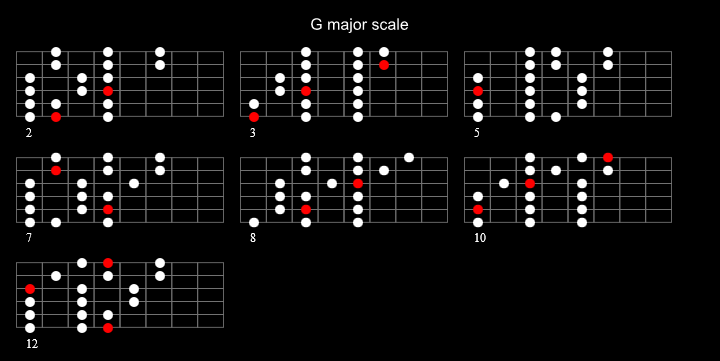
The following exercises will help you learn different fingerings, get familiar with intervals and, of course, learn the 7 positions of the major scale.
Note that the chart with the 7 positions on the neck and the exercises are in the key of G, because it’s the most convenient key to work in. Of course, you just need to shift them along the neck to change key.
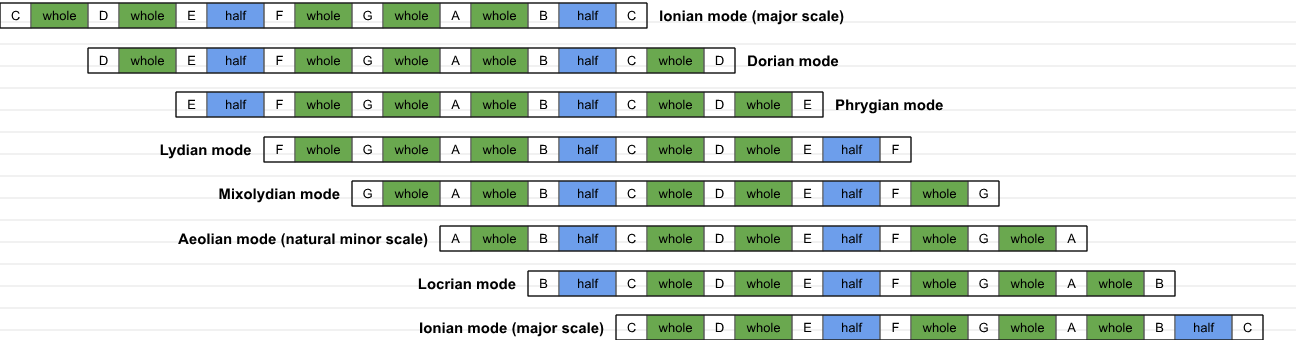
What’s more, and this is the good news of the day, these 7 positions also correspond to the fingerings of the different modes of the major scale, i.e. the Ionian (the major scale itself), Dorian, Phrygian, Lydian, Mixolydian, Aeolian (the natural minor scale) and Locrian modes.
Before going further, the major scale (in the key of C) is made up of the following intervals and notes:
Root – C | whole step | Major second – D | whole step | Major third – E | half step | Fourth – F | whole step | Fifth – G | whole step | Sixth – A | whole step | Major seventh – B | half step | Root (octave) – C
Here’s a chart to visualize the different gaps between the notes, and why the positions of the major scale also correspond to the positions of its modes:
The goal is to learn the 7 positions of the major scale by heart, then work with exercises that let you play in a less mechanical way, so you can improvise and play more open solos.
Practice the different scale positions and the exercises slowly at first, and make sure you play them perfectly before increasing the tempo. Also, if you make a mistake, go back and start again.
Also try to be as fluid as possible, and of course practicing with a metronome is a must for this kind of exercise.
Exercise 1
Learn the 7 positions of the major scale. Play them up and back, start slowly and practice with a metronome. If you have a looper, you can loop the root note and practice over it to really hear the different intervals of the scale.
Exercise 2
In this exercise you play the G major scale in intervals of 3 notes each time, to break automatic habits, get familiar with intervals and learn fingerings you can use in your solos and improvisations.

Exercise 3
Same principle as the previous exercise, but with intervals of 4 notes.

Exercise 4
Same again, the major scale played in intervals of 5 notes this time.

Exercise 5
These three exercises follow the same principle as before, but this time playing the major scale on only two strings.

These exercises are available in the guitar-trainer practice tool. If you want to practice more consistently, with a metronome and a timer, head over here.
Feel free to leave a comment if you spot any mistakes or have tips for practicing better.
Leave a Reply
You must be logged in to post a comment.